
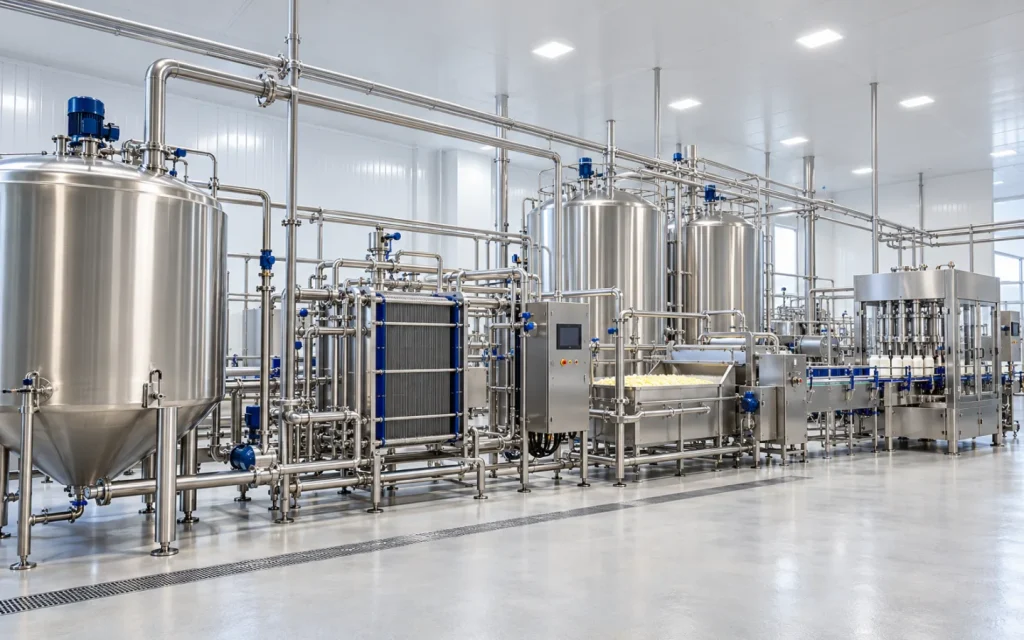
Selecting a dairy line does not start with a machine count. It starts with the finished products, the required process path and a realistic production target. A dependable line balances reception, processing, storage, filling and cleaning as one system.
1. Define the finished products first
Pasteurized milk, yoghurt, labneh and cheese require different heat programs, cooling duties, holding times and downstream operations. Specify the initial products and likely future additions, including fat content, texture, target shelf life, storage temperature and packaging format.
2. Calculate capacity around a real production day
A daily tonnage alone is not enough. State the incoming milk schedule, operating hours, shifts, cleaning time and how production is split between products. Pasteurizer capacity, buffer tanks and filling speed must be balanced because the slowest stage determines the output of the complete line.
- Raw milk volume and delivery schedule.
- Required litres per hour for each product.
- Operating hours and number of shifts.
- Recipe and package changeover frequency.
- Expected expansion over the next two to three years.
3. Approve a process flow before the quotation
A typical flow may include milk reception, filtration and cooling; initial storage; separation and standardisation; homogenisation; heat treatment; cooling; buffer storage; and filling. Cheese adds coagulation, cutting, draining, pressing or brining, while fermented products require controlled incubation tanks.
As a common technical reference, HTST milk pasteurisation is often designed around 72–75°C for 15–20 seconds. The final program must always match the product, validation work and local regulations; it is not one universal setting for every dairy application.
4. Verify utilities and factory layout
Confirm electrical supply, process water, steam or hot water, chilled water, compressed air and drainage. Loads should be calculated after the process is agreed. The layout also needs safe operator movement, maintenance access, raw-material and packaging storage, cold rooms and finished-product flow.
5. Prioritise hygienic design and cleaning
Food-contact surfaces should be suitable for the product, drainable and easy to inspect and clean, with dead legs minimised. A properly designed CIP system makes cleaning repeatable, but its tanks, circuits and flow requirements depend on pipe lengths, vessel sizes and the number of products.
6. Choose a usable automation level
Decide whether operators need assisted manual control, stored recipes or central automation. Temperature, holding time, alarms and critical valve states should be recorded. PLC and HMI programs need controlled access and backups. Automation improves repeatability, but it cannot correct an unbalanced process design.
7. Compare total cost of ownership
Evaluate water and energy use, product loss, cleaning and changeover time, spare-parts availability, training and warranty—not only purchase price. Ask for a pre-shipment acceptance test, a consumables list and a clear installation, commissioning and training plan.
Information required for an accurate proposal
| Input | What to provide |
|---|---|
| Products | Pasteurised milk, yoghurt, white cheese, etc. |
| Capacity | Litres/hour and daily volume per product |
| Packaging | Container, volume, closure and packs/minute |
| Site | Dimensions, power, water, heating and cooling |
| Quality target | Shelf life, storage temperature and regulations |
Next step: explore our dairy and cheese solutions or send your product and capacity data for an initial configuration.