
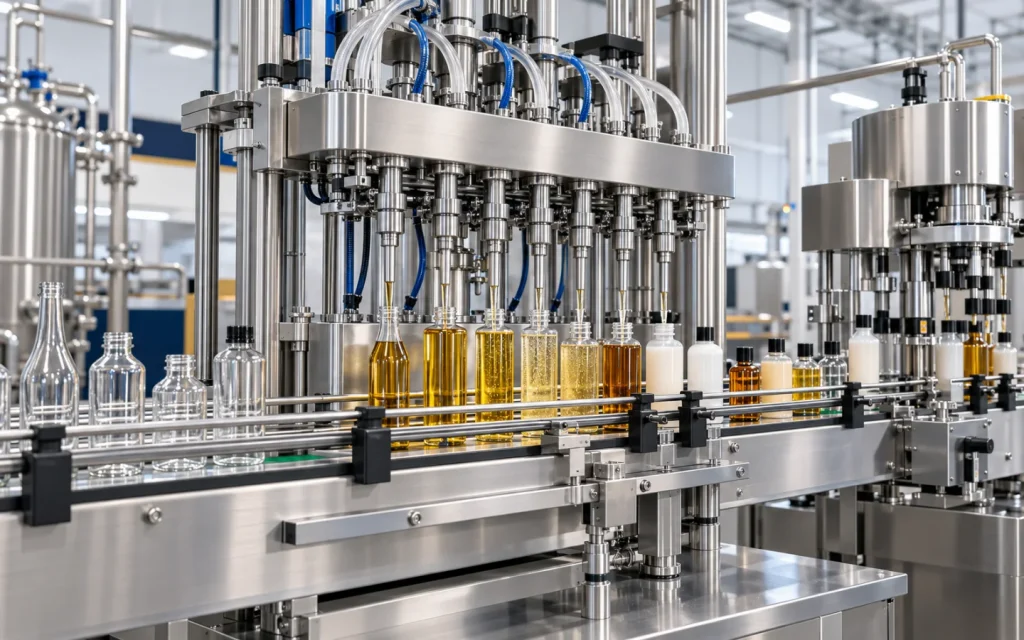
The best filler is not simply the fastest machine on a datasheet. It is the machine that repeatedly delivers the required dose for your product and container, while matching capping, labelling and end-of-line equipment.
1. Product behaviour determines filling technology
Water and light oils behave differently from honey, sauces, creams or products with particles. Specify viscosity at operating temperature, foaming, dissolved gas, particulates or fibres, settling behaviour, oxygen sensitivity and any heating or agitation requirement. Also state whether the application is food, chemical or aseptic.
2. Treat the container as part of the machine
Provide drawings or samples for the container and closure. Important details include nominal volume, dimensions, neck opening, material, stability on a conveyor and real manufacturing tolerances. Lightweight or non-round containers may require dedicated guides and handling, while multiple formats make changeover time and change parts important.
3. Match the measuring principle to the application
| Technology | Typical use | Main decision |
|---|---|---|
| Gravity or timed flow | Free-flowing liquids | Simple operation and dose repeatability |
| Volumetric piston | Viscous or particulate products | Dose size and product pathway |
| Overflow/level fill | Clear containers needing a uniform visual level | Viscosity, foam and bottle geometry |
| Flowmeter or net weight | Recipe-driven direct measurement | Product properties, accuracy and line speed |
This is an initial guide. Testing the actual product and container is the best way to confirm the filling principle, nozzle design and achievable speed.
4. Define accuracy and speed in measurable terms
State the fill volume and acceptable tolerance in millilitres or grams rather than asking only for “high accuracy.” Output should reflect realistic line efficiency, not a momentary maximum. The filler must be balanced with container feeding, capping, labelling, inspection and packing so that the bottleneck does not simply move downstream.
5. Plan sanitation, changeover and maintenance
Specify food-contact materials, seal compatibility and the cleaning method. Food products may need tool-less removal or CIP, while frequent flavour and colour changes benefit from low retained volume. Ask for format-change time, nozzle accessibility, recommended consumables and preventive-maintenance tasks.
6. Choose the right automation and integration level
Semi-automatic equipment can fit start-up and varied short runs; automatic systems suit higher, repeatable throughput. Confirm labour availability, factory space, power, compressed air and interfaces with conveyors, capper, coder and labeller. Guarding, stops and speed control should operate as one coordinated line.
Information checklist for the manufacturer
- Product name, photograph and preferably a sample.
- Viscosity, fill temperature, foam and particulates.
- Container materials, sizes, dimensions and neck opening.
- Closure type and application method.
- Dose size and acceptable tolerance.
- Target containers/minute and daily operating hours.
- Cleaning, materials and regulatory requirements.
- Site layout, electrical supply and compressed air.
Need help selecting the technology? Explore our filling and packaging solutions or send your product and container data.